Program Aims and Objectives
Program Aims
- To provide exceptional training for Family Medicine Residents through development of skills that enable them to provide evidence-based, compassionate, linguistically appropriate patient care with dedication to our community.
- To prepare residents to become health advocates and community leaders.
- To develop competent physicians capable to provide comprehensive care to patients with a broad spectrum of medical conditions as well as support preventative health efforts.
- To promote optimal utilization of resources and cost-conscious strategies to diagnose and manage acute and chronic conditions in patients in both the ambulatory and inpatient setting.
- To support the role of a primary care physician functioning as a member of a multidisciplinary team.
- To advocate for the application of evidence-based medicine while caring for patients in the clinic, hospital, nursing home and home settings.
Program Objectives
Upon completion of the program, all residents will be able to:
Patient Care
- Gather essential and accurate patient information
- Perform an appropriate, accurate and focused physical exam
- Demonstrate caring and respectful behaviors
- Counsel and educate patients and families
- Work within a multidisciplinary team
- Independently develop and carry out patient management plans
- Provide preventative health services and provide anticipatory guidance
- Develop an appropriate differential diagnosis
- Perform procedures appropriate to the field of family medicine
Medical Knowledge
- Know, apply and teach basic and clinical science
- Investigate and review current literature to acquire knowledge and solve clinical inquiries
Practice-based learning and improvement
- Apply, design and use statistical methods to appraise medical studies
- Facilitate the learning of others
- Use information technology for lifelong learning
- Analyze practice experience and improve it systematically
- Obtain and utilize information about individual patients and local populations
Systems-Based Practice
- Be aware of how practice and delivery systems differ (costs, resources, access, etc.)
- Practice cost-effective care and resource allocation
- Advocate for quality and help patients manage the health care system
Professionalism
- Demonstrate respect, compassion, dignity and integrity
- Demonstrate sensitivity to cultural, age, gender, sexual orientation and disability issues
- Demonstrate commitment to ethically sound practice
- Demonstrate responsiveness and accountability to society, individual patients and the profession of medicine.
Interpersonal and Communication Skills
- Effectively listen, elicit and provide information
- Communicate to develop and maintain therapeutic relationships with patients
- Work well with others as a member or leader of a health team
- Utilize communication to create health-promoting partnerships with patients and their families of various cultures and ethnic backgrounds
Curriculum
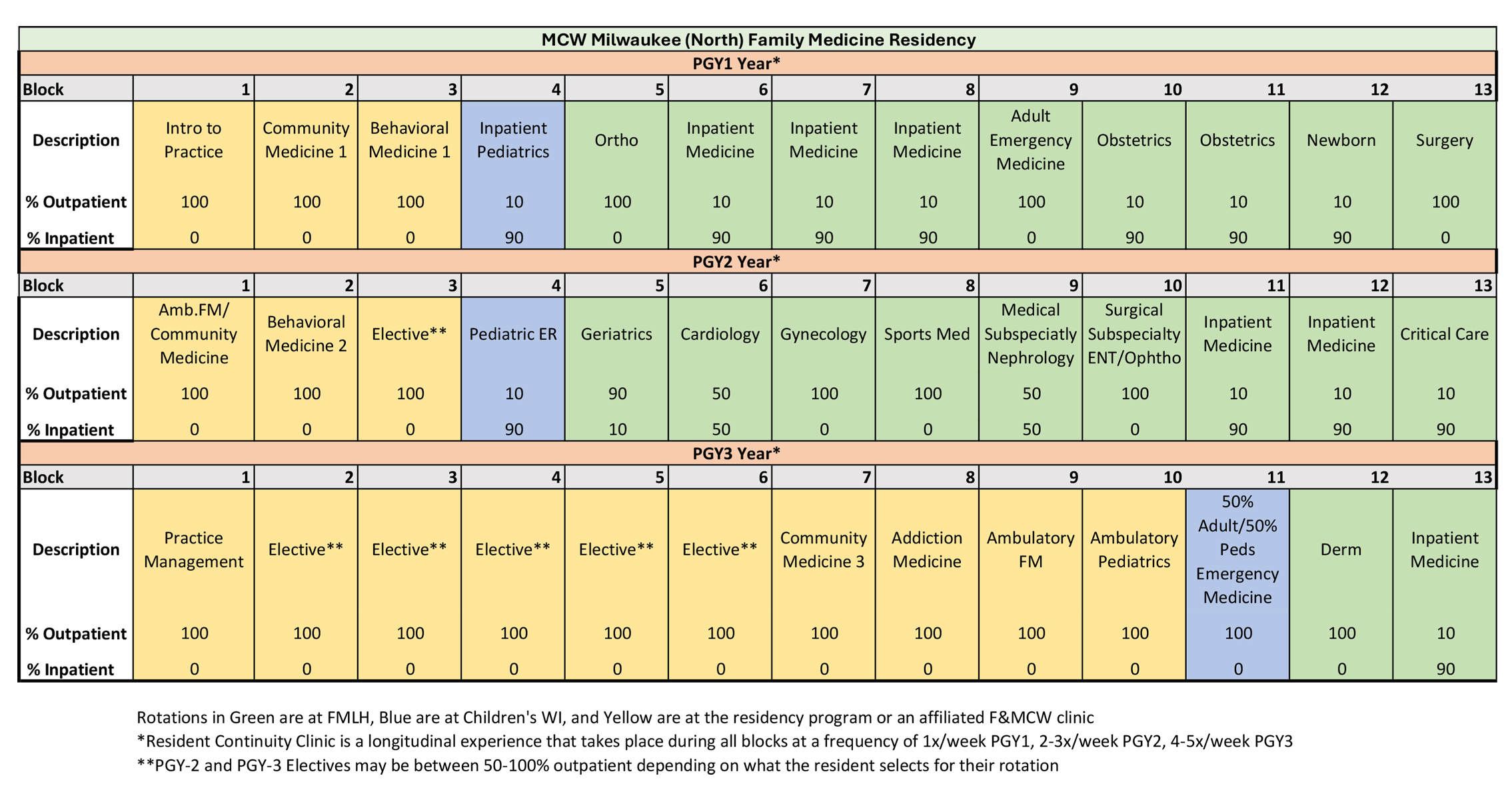
Rotations will be scheduled for 4 week rotation blocks. There are 39 total blocks throughout the 3 years of training. Outpatient rotations will occur at Outreach Community Health Center and other affiliated community health centers, Froedtert & MCW specialty office practices, and North Side community organizations. Inpatient adult medicine rotations and specialty rotations will occur at Froedtert Hospital. Inpatient pediatric and emergency medicine rotations will occur at Children’s Wisconsin.
PGY-1:
- 1 block Introduction to practice
- 3 blocks inpatient adult medicine
- 1 block adult and pediatric emergency medicine
- 2 blocks obstetrics
- 1 block inpatient pediatrics
- 1 block surgery
- 1 block community medicine
- 1 block care of newborns
- 1 block orthopedics
- 1 block behavioral medicine
PGY-2:
- 2 blocks adult inpatient medicine
- 1 block adult and pediatric emergency medicine
- 1 block behavioral medicine
- 1 block cardiology
- 1 block subspecialty medicine
- 1 block subspecialty surgery
- 1 block sports medicine
- 1 block critical care
- 1 block community medicine
- 1 block geriatrics
- 1 block gynecology
- 1 block elective
PGY-3:
- 1 block adult inpatient medicine
- 1 block adult and pediatric emergency medicine
- 1 block practice management
- 1 block community medicine
- 1 block addiction medicine
- 1 block ambulatory pediatrics
- 1 block ambulatory family medicine
- 1 block dermatology
- 5 blocks electives